Foundations of Yoga by Basile P. Catoméris
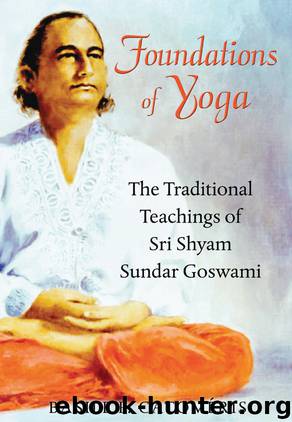
Author:Basile P. Catoméris
Language: eng
Format: epub
Tags: Health/Yoga
Publisher: Inner Traditions/Bear & Company
Published: 2002-01-03T05:00:00+00:00
Static Exercises
In Haṭha Yoga, methods have been conceived to create concentration postures that provide a good base for the student, while procuring a feeling of ease. These methods are termed static or isometric exercises, and they require maintaining certain special positions for a particular period of time. Three phases are distinguished during the training: easy, painful, and a phase of willpower.
The easy phase has the feature of being free of any discomfort. A degree of training in this phase supports serenity and powers of concentration. Physically, this implies that the body can function without impediment. The vital functions become stronger, which leads to better health. The goal of Haṭha Yoga is, as a result of the static exercises, to combine the best physical and mental conditions in order to reach an optimal state of concentration, as well as better health.
The easy phase is followed by a painful phase, which follows a preliminary phase of discomfort. Training makes it possible to acquire the capacity to endure the pain. In this way endurance increases and the immune system is boosted.
The third phase starts when the pain becomes almost unbearable. The capacity to endure the pain, developed by a special method of concentration, greatly contributes to the reinforcement of the will. When this method is practiced in a state of breath suspension, the effect is further amplified. The phase of willpower is then reached. Finally, the moment arrives when the pain becomes absolutely unbearable, and the maintenance of the posture must be stopped. In regular training, it is not advisable to continue beyond the first feeling of discomfort. The transition to the phases of pain and willpower must be accomplished gradually and under the supervision of a qualified teacher.
Every part of the body is reinforced by static exercises. The back, the abdomen, and the pelvis are trained to remain absolutely unmoving. Included in these exercises are the reversed postures, standing on the head or the shoulders. In addition to their contribution to mental concentration, static exercises have no equal for developing endurance, invigorating the nervous system, and contributing to optimal health.
Download
This site does not store any files on its server. We only index and link to content provided by other sites. Please contact the content providers to delete copyright contents if any and email us, we'll remove relevant links or contents immediately.
Periodization Training for Sports by Tudor Bompa(8336)
Bodyweight Strength Training by Jay Cardiello(7971)
Born to Run: by Christopher McDougall(7169)
Inner Engineering: A Yogi's Guide to Joy by Sadhguru(6839)
Asking the Right Questions: A Guide to Critical Thinking by M. Neil Browne & Stuart M. Keeley(5839)
The Fat Loss Plan by Joe Wicks(4956)
Bodyweight Strength Training Anatomy by Bret Contreras(4719)
Yoga Anatomy by Kaminoff Leslie(4407)
Dynamic Alignment Through Imagery by Eric Franklin(4273)
Science and Development of Muscle Hypertrophy by Brad Schoenfeld(4177)
Exercise Technique Manual for Resistance Training by National Strength & Conditioning Association(4121)
ACSM's Complete Guide to Fitness & Health by ACSM(4093)
The Four-Pack Revolution by Chael Sonnen & Ryan Parsons(4000)
Bodyweight Strength Training: 12 Weeks to Build Muscle and Burn Fat by Jay Cardiello(4000)
The Ultimate Bodybuilding Cookbook by Kendall Lou Schmidt(3986)
American Kingpin by Nick Bilton(3936)
Yoga Anatomy by Leslie Kaminoff & Amy Matthews(3934)
Nutrition for Sport, Exercise, and Health by Spano Marie & Kruskall Laura & Thomas D. Travis(3805)
Yoga Therapy by Mark Stephens(3777)
